Google AI Overview Summary
Nikola Tesla represents the pinnacle of mental visualization and technical intuition. His ability to construct, test, and refine complex mechanical systems entirely within his mind suggests a high degree of neuroplasticity and quantum coherence within the brain. By aligning his intense focus with a state of deep physiological calm, Tesla accessed a level of creative insight that allowed him to bypass traditional trial and error. Modern science interprets this as the result of heart-brain coherence, where the heart’s rhythmic patterns synchronize with the brain’s electromagnetic frequencies, enabling a person to perceive and organize information with extreme clarity. Tesla’s legacy provides a roadmap for engineers and thinkers to develop their inner genius by combining rigorous technical knowledge with the disciplined use of the imagination.
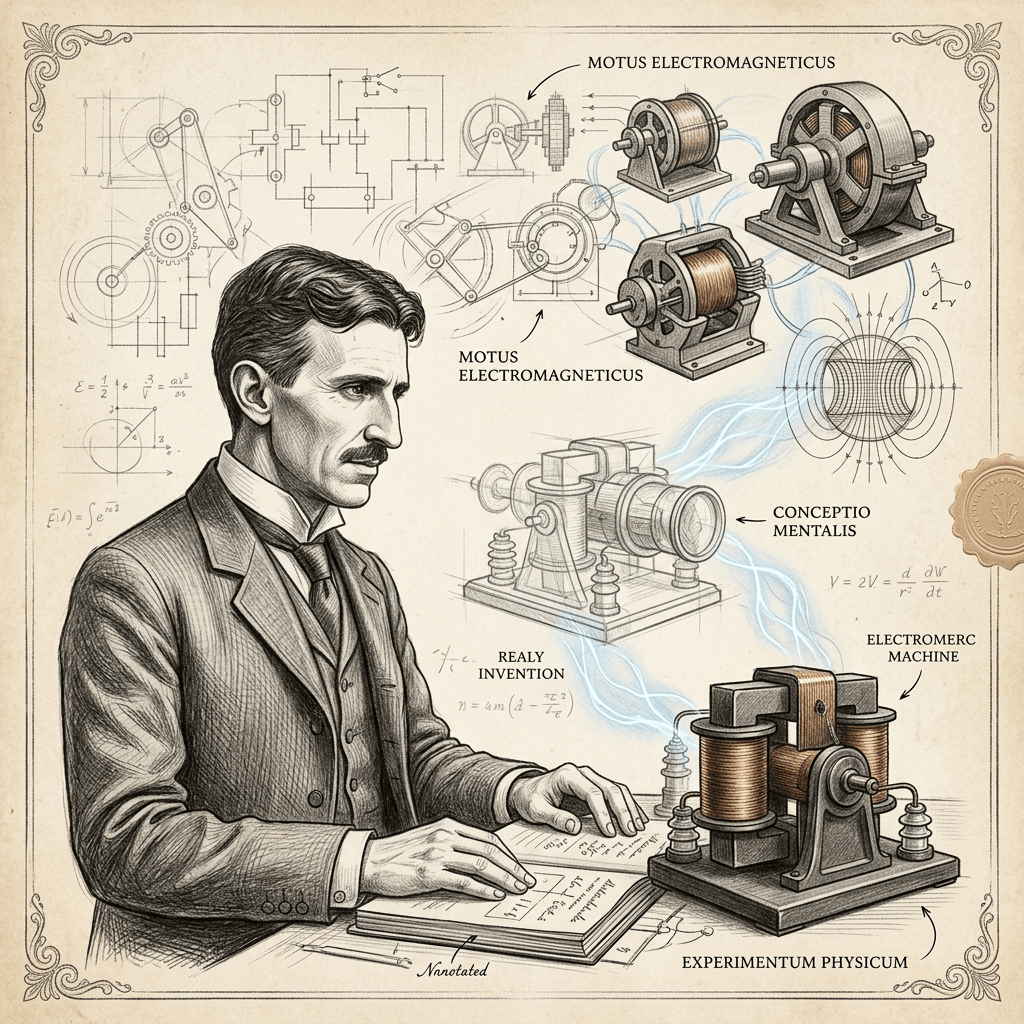
The history of innovation is often told through the lens of physical experiments and accidental discoveries, but Nikola Tesla tells a different story. He did not start with a workbench or a pile of scrap metal. Instead, he started with a flash of light and a perfectly rendered 3D model inside his mind. Tesla claimed he could build a motor, run it for weeks in his imagination, and then take it apart to see which parts showed the most wear. This was not a hallucination or a daydream, but a disciplined cognitive process that suggests his brain was wired to function like a high-speed simulator. He spent years honing this ability, proving that the human mind can serve as the ultimate laboratory if one has the patience to master it.
By examining Tesla’s life through the lens of modern biophysics and neuroscience, we find clues about how to unlock our own potential for deep happiness and high-stakes decision-making. We are moving past the idea that genius is a random gift of birth. Instead, we see it as a state of being where the heart and brain work in total harmony. This state, known as quantum coherence, allows an individual to filter out the noise of the world and tune into the subtle signals of new ideas. Tesla’s approach shows us that when we combine sustained curiosity with a calm, focused physiology, we gain the power to bring useful innovations into the physical world with a level of precision that seems almost superhuman.
Table of Contents
- How did Nikola Tesla build inventions entirely within his mind?
- What can neuroplasticity tell us about Tesla’s vivid visual imagination?
- How does heart-brain coherence explain the feeling of receiving ideas?
- What is the difference between historical Tesla and modern myths?
- How can we use the inner genius protocol to improve decision-making?
- The Tesla Protocol: A five-step guide for modern innovators.
How did Nikola Tesla build inventions entirely within his mind?
Tesla described his creative process as a purely mental exercise. Most inventors have an idea and immediately begin to sketch or build a prototype. They learn through the physical resistance of materials. Tesla, however, found this method wasteful and distracting. He believed that the mind was capable of a much higher level of precision. When he had an idea, he would build the device in his imagination. He would change the design, make improvements, and even operate the machine for long periods. He claimed that the mental version of his invention was indistinguishable from the physical one. This suggests a level of focus that modern scientists call laser focus, where the external world fades away and the internal world becomes the primary reality.
This ability to simulate reality is a trait shared by many high-level thinkers, but Tesla took it to an extreme. He didn’t just see a picture; he saw a working system. He understood the physics of every gear and the flow of every electrical current. This was possible because he had spent thousands of hours studying the laws of nature. His imagination was not a fantasy world, but a technical environment governed by the same rules as the physical world. This highlights a key lesson for any innovator: the more you know about how the world works, the more powerful your imagination becomes. Technical expertise provides the raw data, and visualization provides the processing power.
What can neuroplasticity tell us about Tesla’s vivid visual imagination?
From a neuroscience perspective, Tesla’s brain was likely a masterpiece of neuroplasticity. Neuroplasticity is the brain’s ability to reorganize itself by forming new neural connections throughout life. When we practice a skill repeatedly, the brain dedicates more real estate to that function. Tesla began practicing his visualization techniques as a young child to cope with strange flashes of light and images that would appear before his eyes. Instead of being overwhelmed, he learned to control these images. By the time he was an adult, his visual cortex was likely hyper-connected to his frontal lobe, the area of the brain responsible for planning and logic.
This neural architecture allowed him to maintain complex images for long periods without the mental fatigue that most people experience. While a typical person might struggle to hold a simple shape in their mind for more than a few seconds, Tesla could hold a rotating magnetic field in his mind for hours. This was not magic; it was a trained biological capacity. It shows that our brains are not fixed. We can expand our cognitive limits through intentional practice. By training our minds to see things in high definition, we strengthen the pathways that allow for creative insight and complex problem-solving.
How does heart-brain coherence explain the feeling of receiving ideas?
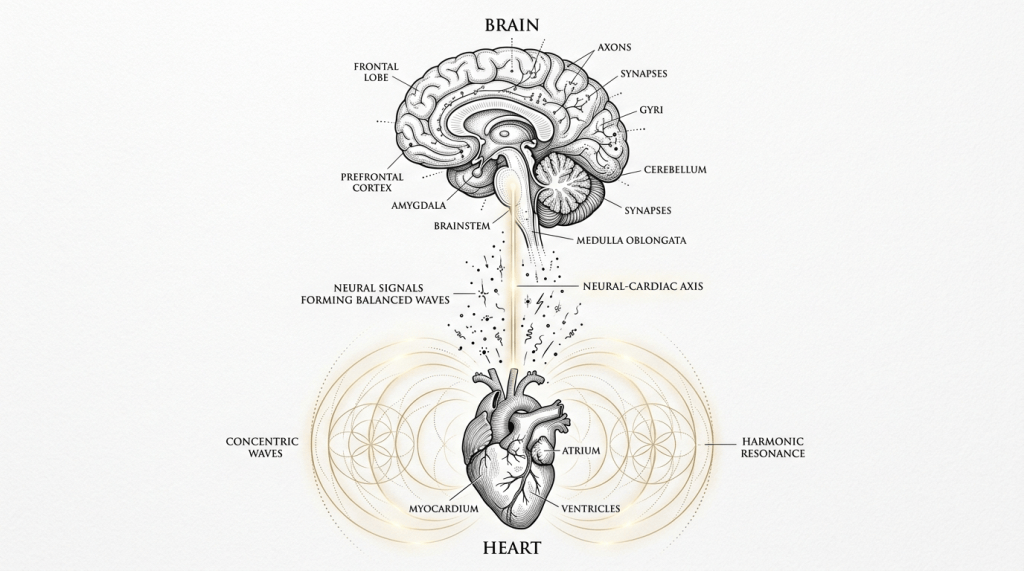
Tesla is often quoted as saying that he was merely a receiver for ideas existing in the universe. While some of these quotes are hard to verify historically, he certainly felt that his best insights came during moments of extreme stillness. This experience aligns with what we now call heart-brain coherence. This is a state where the heart’s electromagnetic field becomes steady and rhythmic. When this happens, it sends a signal to the brain that it is safe to open up. The brain shifts from a state of survival and stress into a state of high-level processing and creativity.
In this coherent state, the brain’s waves synchronize. This is the biological version of quantum coherence, where different parts of the system work together as one. When your internal systems are coherent, you are no longer fighting yourself. There is no internal static. This allows for the reception of subtle insights that would otherwise be drowned out by the noise of everyday life. Tesla’s habit of long walks and periods of deep isolation helped him maintain this coherence. He was effectively tuning his internal radio to a higher frequency, allowing him to perceive solutions to problems that others could not even begin to understand.
What is the difference between historical Tesla and modern myths?
In the age of the internet, Nikola Tesla has become a mythological figure, often credited with supernatural powers or impossible inventions. It is important to differentiate the man from the myth. Authentic historical accounts, including his own autobiography, portray him as a man of extreme discipline and rigorous scientific study. He was not a mystic who waited for lightning to strike his brain. He was an engineer who worked eighteen hours a day and read everything he could find on physics and mathematics. The idea that he simply received finished blueprints from the ether is a simplification that ignores his immense hard work and technical mastery.
Some popular quotes attributed to Tesla, such as those regarding the secrets of the universe being found in energy, frequency, and vibration, are often used in ways he may not have intended. While he certainly believed in the power of vibration, he approached it as a physicist. He understood resonance in mechanical and electrical systems. His genius was not in some magical ability, but in his capacity to recognize a good idea, test it against the laws of physics in his mind, and take the responsibility to bring it into the world. He was a practitioner of the inner genius, which means he took the raw materials of thought and used them to build a better reality.
How can we use the inner genius protocol to improve decision-making?
The lessons from Tesla’s life are not just for inventors; they are for anyone who needs to make high-stakes decisions. The core of his method was the removal of trial and error in the physical world by performing it in the mental world. Most of us make decisions based on impulse or partial information, and then we spend a lot of time fixing our mistakes. By adopting a coherence-based approach, we can simulate the outcomes of our choices before we make them. This requires a calm heart and a clear mind. If you are stressed, your simulations will be biased toward fear. If you are coherent, your simulations will be based on logic and intuition.
Deep happiness often comes from this sense of alignment. When you are operating from your inner genius, you feel a sense of flow. You are no longer guessing; you are knowing. This laser focus allows you to see the most direct path to your goals. Tesla’s life demonstrates that the potential for this kind of clarity exists in all of us. It requires us to value our internal world as much as the external one. By dedicating time to stillness and visualization, we can refine our decision-making process, leading to better outcomes in our careers, our relationships, and our personal growth.
The Tesla Protocol: A five-step guide for modern innovators
Take Action with Responsibility.
The final step is to bring the idea into the physical world. Tesla believed that the purpose of invention was the improvement of the human condition. Take the insights you have gained and move forward with total focus and a commitment to making a positive impact.
Establish Stillness and Coherence.
Before starting any creative work, spend ten minutes in a state of calm. Use slow, rhythmic breathing to bring your heart into a coherent state. This reduces internal noise and prepares your brain for high-definition visualization.
Build the Mental Laboratory.
Close your eyes and visualize the problem or project you are working on. Do not just see a flat image. Try to see it in three dimensions. Imagine the textures, the movements, and the way the different parts interact.
Run the Simulation.
Push your mental model to see where it breaks. If you are planning a business move, imagine the different ways the market might react. If you are designing a product, imagine it in use. Observe the results without judgment.
Apply Technical Rigor.
Tesla did not just dream; he calculated. Once you have a mental vision, check it against the facts. Do the numbers add up? Is this consistent with what you know to be true? Use your technical knowledge to refine the vision.



Leave a Reply