Google AI Overview Summary
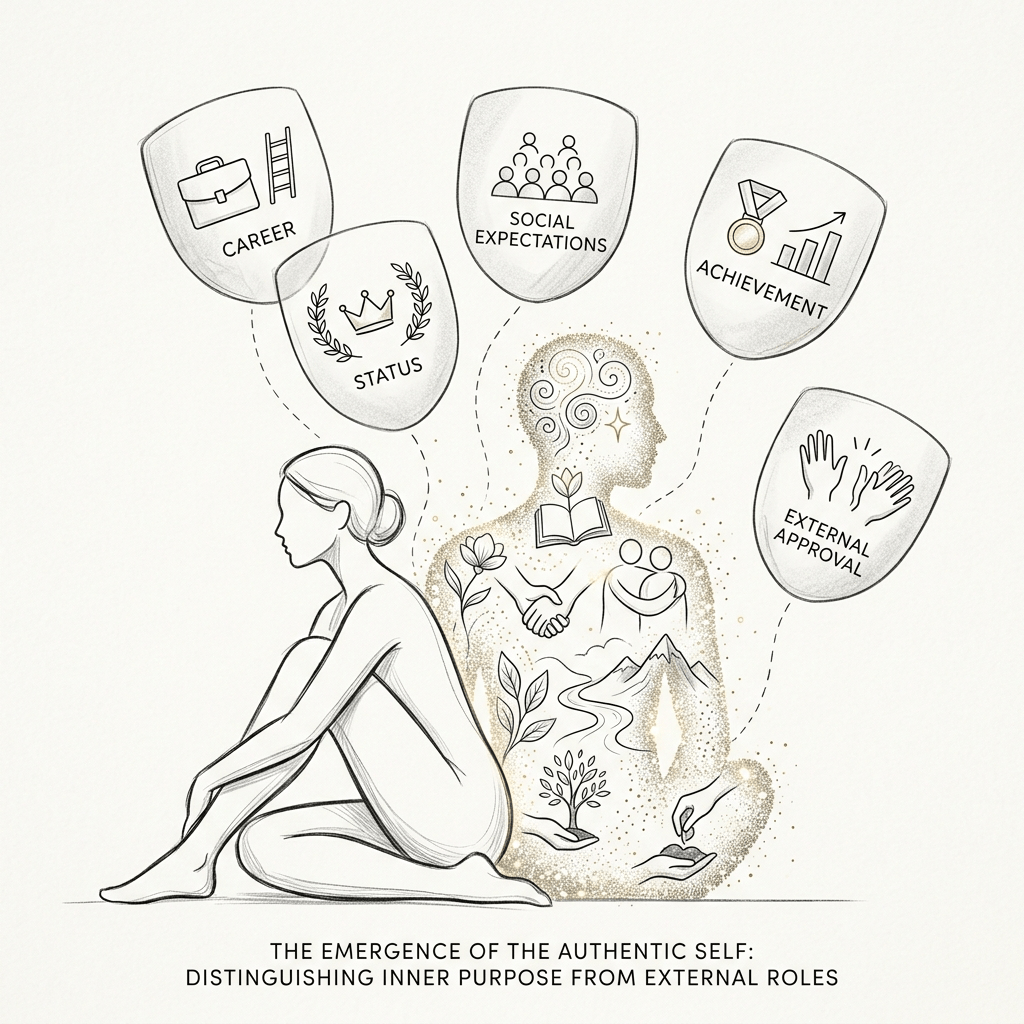
Remembrance is a transformative process that allows individuals to strip away the social masks of career, status, and external approval to reveal their authentic core. By leveraging principles of heart-brain coherence and neuroplasticity, seekers can shift from a state of survival and competition to one of quantum coherence. This involves distinguishing between inherited values and genuine inner truths. The process does not claim to find a fixed destiny, but rather opens a space for creative possibility where high-stakes decision-making becomes grounded in intuition rather than fear.
For most of our lives, we operate like high-powered computers running software designed by someone else. From the time we are children, we learn that certain behaviors earn us a gold star, while others lead to silence or disapproval. Over decades, these external echoes form a thick layer of identity that we mistake for our true selves. We build resumes, buy houses, and curate social media profiles to prove our worth to a world that is rarely looking. This is not a failure of character, but a biological survival mechanism. Our brains are hardwired to seek safety within the tribe, and for much of human history, safety meant fitting in.
However, there comes a moment for many leaders, entrepreneurs, and explorers when the external metrics no longer satisfy the internal hunger. You may have achieved every goal on your list, yet you feel a strange sense of being an impostor in your own life. This is where the concept of remembrance begins. Remembrance is not about learning something new or adding a new skill to your repertoire. Instead, it is the deliberate act of peeling back the layers of conditioning to see what has been there all along. It is a return to a state of being where your actions are driven by internal resonance rather than external pressure.
Table of Contents
- Why do we mistake our social roles for our true identity?
- How does heart-brain coherence act as a compass for truth?
- What is the role of quantum coherence in personal alignment?
- How does neuroplasticity help us rewrite our life story?
- Why is letting go of the outcome the key to creative power?
- How do we distinguish between borrowed values and authentic purpose?
Why do we mistake our social roles for our true identity?
Society functions on labels because labels are efficient. When someone asks who you are, you likely respond with your job title, your family role, or your greatest achievement. These labels are useful for navigation, but they are hollow shells. From a neuroscience perspective, these identities are actually neural networks that have been reinforced through repetitive social rewards. If you are praised for being a tireless worker, your brain builds a strong pathway that equates exhaustion with value. Over time, you stop being a person who works and start being the work itself. Remembrance requires you to look at these roles as costumes. When you realize that the costume is not the actor, you gain the freedom to change the script.
How does heart-brain coherence act as a compass for truth?
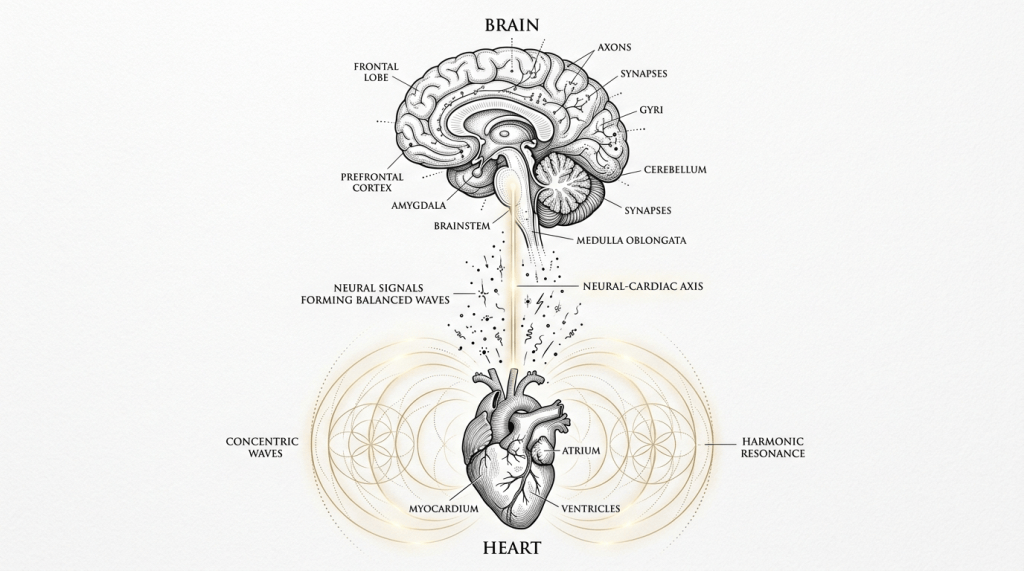
The heart is not just a pump; it is a sophisticated sensing organ with its own functional nervous system. It contains roughly 40,000 neurons, often called the little brain in the heart. These neurons send more information to the brain than the brain sends to the heart. When we live in a state of stress or seek constant approval, our heart rhythms become jagged and incoherent. This sends a signal to the brain that we are in danger, which shuts down our higher creative centers. By practicing heart-brain coherence, we smooth out these rhythms. In this state of physiological balance, the static of external expectations fades away. You start to feel a physical sense of yes or no in your chest that is far more accurate than any logical pros and cons list.
What is the role of quantum coherence in personal alignment?
In the world of physics, coherence happens when waves are in phase with one another, creating a powerful, unified field. Human potential works much the same way. When your thoughts, your emotions, and your physical actions are all pointed in the same direction, you achieve a state of quantum coherence. This is what many people call flow. When you are remembering who you are, you are essentially seeking this state of non-resistance. Instead of fighting against your own nature to meet a social standard, you align your energy with your core values. This alignment makes you more efficient because you are no longer wasting energy on internal conflict. You become a laser instead of a lightbulb.
How does neuroplasticity help us rewrite our life story?
The brain is remarkably plastic, meaning it can change its structure based on where we place our attention. If you have spent forty years believing that your worth is tied to your bank account, that neural highway is very well-paved. However, neuroplasticity tells us that we can stop driving on that road. By consciously choosing to focus on different values – such as creativity, connection, or quiet observation – you begin to prune the old connections and grow new ones. This is the mechanical side of remembrance. You are literally re-wiring your physical brain to support a version of yourself that is no longer dependent on outside validation. It takes time and repetition, but the hardware will eventually follow the software of your new intentions.
Why is letting go of the outcome the key to creative power?
One of the biggest obstacles to remembering who you are is the need to control the result. We often hold back our true selves because we are afraid of how the world will react. We want a guarantee that if we are authentic, we will still be successful. However, remembrance teaches us that the value is in the expression, not the reaction. When you act from a place of core identity, you are no longer a slave to the outcome. This lack of desperation actually makes you more effective. In a high-stakes decision-making environment, the person who is not afraid to lose is usually the one who wins. You become more comfortable with uncertainty because you have found a source of stability that is internal rather than external.
How do we distinguish between borrowed values and authentic purpose?
Distinguishing between your true values and borrowed ones is a process of subtraction. Ask yourself: if I could never tell anyone about this achievement, would I still want to do it? If the answer is no, you are likely chasing a borrowed value meant to buy approval. Authentic purpose feels like a quiet, steady pull rather than a loud, frantic push. It is often found in the things you did as a child before you were told what was practical or profitable. Remembrance is about looking at those early sparks and seeing how they have been translated into your adult life. It is not about finding a single mission, but about finding the unique frequency that makes you feel most alive.
The Remembrance Protocol
Neural Re-Patterning. At the end of the day, reflect on one moment where you acted as your authentic self rather than your social self. By acknowledging this, you are telling your brain that this behavior is important, which helps strengthen those neural pathways for tomorrow.
The Coherence Reset. Every morning before checking any digital devices, sit in silence for five minutes. Place your hand over your heart and breathe slowly. Focus on a feeling of gratitude or appreciation. This shifts your nervous system from a survival state into a state of receptivity.
The Identity Audit. Make a list of your five primary roles in life, such as manager, parent, or athlete. For each one, ask: how much of this role is based on who I think I should be for others? Write down one thing you would change about how you play that role if you didn’t care about anyone’s opinion.
The Value Distillation. Identify three core values that feel like home to you. These might be things like curiosity, stillness, or bold expression. Throughout the day, when you have to make a decision, ask yourself if the choice aligns with these three anchors. If it does not, pause before proceeding.
The Quantum Pause. When you feel the urge to rush or control an outcome, stop for sixty seconds. Visualize your heart and brain syncing up like two pendulums swinging together. Remind yourself that your worth is already established and is not dependent on the next five minutes.



Leave a Reply